

 EN
 ZH
 AR
 DE
 ES
 FA
 FR
 HI
 ID
 IT
 JA
 KO
 NL
 PL
 PT
 RU
 TH
 TR
 VI
2 kW Wind + 2 kWp Solar Hybrid System Off-grid, on-grid with battery, and on-grid without battery
2026-10-27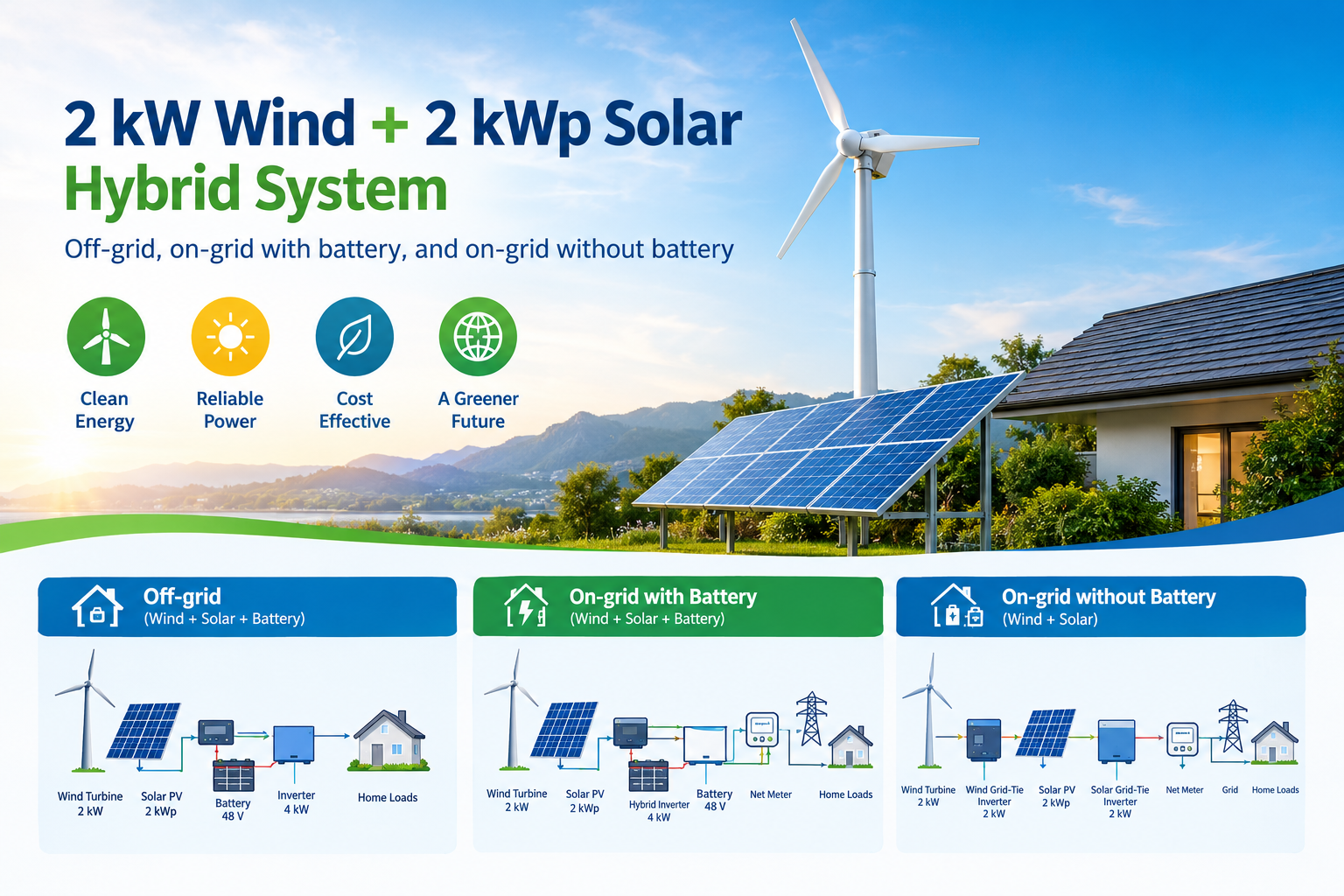
Solar Hybrid System
2 kW Wind + 2 kWp Solar Hybrid System
Off-grid, on-grid with battery, and on-grid without battery
Overview
This design combines a 2 kW wind turbine with a 2 kWp solar PV array. Sun and wind are often available at different times of day and in different seasons, so the two sources complement each other and deliver more stable energy than either alone. Three configurations are shown below, depending on whether the site has a grid connection and whether battery storage is needed.
Design basis
The figures below are a worked example. Replace them with measured site data before installation.
| Parameter | Value | Notes |
| Wind turbine | 2 kW, 48 V PMG, direct drive | Average wind 5–6 m/s at hub height |
| Wind energy | About 9.6 kWh/day | 20% capacity factor (assumed) |
| Solar PV array | 2 kWp (4 × 500 W panels) | Two strings of two panels in series |
| Solar energy | About 6.4 kWh/day | 4.0 peak sun hours; performance ratio 0.80 (assumed) |
| Total generation | About 16 kWh/day | Average day; varies by season |
| Daily load | 6 kWh/day | From load audit |
| Surplus energy | About 10 kWh/day | Charges battery, then exported or dumped |
| Peak load | 3 kW | Sets inverter size |
Solar PV sizing
•Array: 4 panels × 500 W = 2.0 kWp, in two parallel strings of two panels in series.
•Voltage: about 80 V (Vmp) and 100 V (Voc) per string at 25 °C. Check Voc at the coldest expected temperature (about 10–15% higher) against the controller limit.
•Off-grid: a 60 A solar MPPT controller at 48 V gives margin over the 42 A needed for 2 kW.
•DC cable: 4–6 mm² outdoor-rated PV cable, at least 1000 V DC, with 15 A fuses per string.
System configurations:
| Off-grid with battery | On-grid with battery | On-grid, no battery | |
| Purpose | Full power without a grid | Self-consumption and backup during outages | Lowest cost; export to grid |
| Battery | 48 V 300 Ah LiFePO₄ (14.4 kWh; about 12.2 kWh usable; 2 days of load) | 48 V 200 Ah LiFePO₄ (9.6 kWh; about 8.6 kWh usable; covers an 8 h outage at 1 kW) | None |
| Inverter | 4 kW pure sine wave, 48 V DC to 230 V AC | 4 kW hybrid, 48 V battery input, at least 2.5 kWp PV input, grid-tie and backup | Two grid-tie inverters, 2 kW each (wind and solar) |
| Grid outage | Not applicable | Essential loads stay powered from battery, solar and wind | Supply stops (anti-islanding) |
| Autonomy | About 2 days with no wind or sun | About 8 h of essential loads | None |
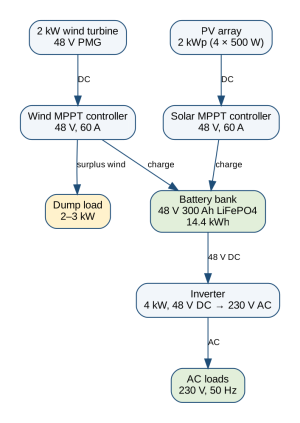
Off-grid (wind + solar + battery)
•2 kW wind turbine with overspeed brake, 12–18 m tower.
•Wind MPPT controller (48 V, 60 A) with dump-load output and a 2–3 kW dump load for surplus wind energy.
•Solar MPPT controller (48 V, 60 A), 4 × 500 W panels, PV isolator and string fuses.
•Battery bank 48 V 300 Ah LiFePO₄ with integrated BMS; 4 kW pure sine wave inverter; DC protection and AC distribution with 30 mA RCD.
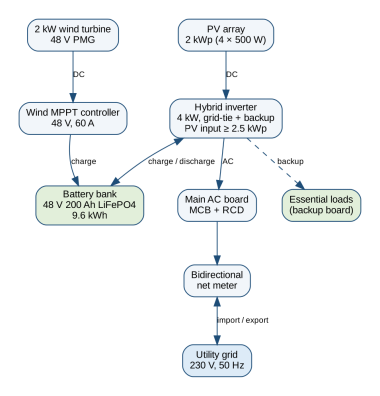
On-grid with battery backup (wind + solar)
•2 kW wind turbine with brake or shunt, 12–18 m tower, and a 48 V MPPT wind controller.
•4 × 500 W solar panels (2.0 kWp) connected to a 4 kW hybrid inverter with grid-tie, battery charging and automatic backup changeover.
•Battery bank 48 V 200 Ah LiFePO₄ with integrated BMS; bidirectional net meter; main AC board; backup switch for essential circuits.
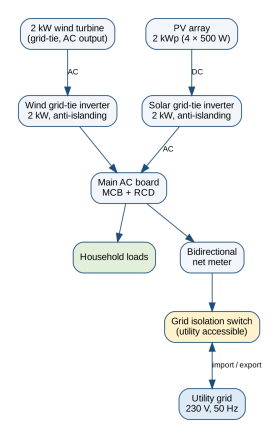
On-grid without battery (wind + solar)
•2 kW wind turbine (grid-tie type, AC output) on a 12–18 m tower.
•2 kW wind grid-tie inverter and 2 kW solar grid-tie inverter (4 kW total), both certified to grid code with anti-islanding.
•4 × 500 W solar panels (2.0 kWp), bidirectional net meter, and a grid isolation switch accessible to the utility.
Controller summary:
| Controller | Off-grid (battery) | On-grid with battery | On-grid (no battery) |
| Wind MPPT controller | Required | Required | Not required (wind grid-tie inverter) |
| Solar MPPT charge controller | Required | Included in hybrid inverter | Not required (solar grid-tie inverter) |
| Turbine brake / shunt | Required | Required | Required |
| Dump load controller | Required | Only if export is forbidden | Not required |
| Off-grid inverter control | Required | Not required | Not required |
| Grid-tie inverter control | Not required | Required (hybrid) | Required (two units) |
| Battery management system | Required | Required | Not required |
| Automatic backup changeover | Not required | Required (hybrid) | Not required |
| Export limit controller | Not required | Only if utility requires | Only if utility requires |
Safety essentials
•Confirm local rules for tower height, setbacks, building permits, roof loading and grid connection before work starts.
•Earthing: 10 Ω or less; PV frames and the tower must be bonded to it. Test before energising.
•Check PV string Voc against the controller maximum at the coldest expected temperature.
•Isolate PV at the DC isolator before working on panels. Never disconnect a live DC string under load.
•Never work on a running turbine. Apply the brake before climbing the tower.
•Install surge protection (SPD) on the turbine, PV and AC sides.
Disclaimer
This is a general design guide for a combined 2 kW wind and 2 kWp solar system, based on the assumptions stated above. It is not a substitute for a site-specific engineering design. Equipment ratings, cable sizes, protection settings, structures and grid approvals must be confirmed against manufacturer datasheets, local electrical codes and utility requirements.